
PCB Design in the Digital Age: Challenges and Solutions for a Smart Future
The world is experiencing an accelerated digital transformation, where technological innovation is bursting in at an increasingly rapid pace. Areas such as artificial intelligence (AI) and machine learning (ML) are radically changing the way we live, work and communicate. As a result, PCB Design (Printed Circuit Board Design) also faces new challenges to keep up with this changing environment.
Over the past decades, thousands of technology companies have steadily churned out increasingly sophisticated electronic innovations. Now, in the digital age, PCB designers are challenged to develop smarter, connected, and faster products to meet the needs of a rapidly changing market.
Var Industries and Siemens help companies of all sizes tackle their Digital Transformation and design a smarter future faster, starting with PCB Design.
How to design the PCB
The design of PCBs, which increasingly involves the design of complete PCB systems continuously challenged to adequately power and cool a new generation of faster and more complex integrated circuits. At the same time, it must ensure proper routing and maintain the thermal integrity of every high-speed signal between integrated circuits on the board.
These challenges, and the technologies required to address them, must encompass all boards within a system and remain synchronized with the related mechanical systems.
Design teams are increasingly required to deliver highly complex electronic boards and interconnected systems that provide best-in-class performance at the lowest possible power, all within ever-shorter time-to-market windows.
However, the challenges extend beyond design complexity and time constraints.
Siemens Digital Industries Software technologies enable customers to effectively address, while minimizing revisions and re-spins, the product, organizational, and process complexities that often prevent companies from delivering PCBs and interconnected electronic systems on schedule.
These technologies include the Xpedition Enterprise and PADS Professional design flows, as well as the closely integrated analysis suites HyperLynx and Valor NPI.
These challenges, and the technologies required to address them, must encompass all boards within a system and remain synchronized with the related mechanical systems.
Design teams are increasingly required to deliver highly complex electronic boards and interconnected systems that provide best-in-class performance at the lowest possible power, all within ever-shorter time-to-market windows.
However, the challenges extend beyond design complexity and time constraints.
Siemens Digital Industries Software technologies enable customers to effectively address, while minimizing revisions and re-spins, the product, organizational, and process complexities that often prevent companies from delivering PCBs and interconnected electronic systems on schedule.
These technologies include the Xpedition Enterprise and PADS Professional design flows, as well as the closely integrated analysis suites HyperLynx and Valor NPI.

The best software for PCB design
When it comes to choosing the best PCB design software, two names stand out on the market: Xpedition Enterprise and PADS Professional, both developed by Siemens EDA. These tools are renowned for their reliability and powerful features, making them ideal for a variety of electronic design needs.
Xpedition Enterprise is the perfect solution for large companies and development teams working on large-scale, complex projects. This software offers a comprehensive suite of advanced tools that facilitate the management of intricate projects, improving efficiency and collaboration among team members. With its simulation and verification capabilities, Xpedition Enterprise ensures that every project is carried out with the highest accuracy and quality.
On the other hand, PADS Professional is distinguished by its user-friendly interface and powerful design tools, making it ideal for both individual designers and small teams. This software combines ease of use with advanced functionality, enabling designers to create high-quality PCBs without facing a steep learning curve. PADS Professional is perfect for those seeking a balance between ease of use and power, offering design tools that can be used by anyone from beginners to experts.
Five reasons why you should choose us as your PCB Design partner
For more effective product differentiation, better profitability, and faster time-to-market through PCB Design, five elements of transformation are needed:
- Digitally integrated and optimized multi-domain design.
- Model-Based Systems Engineering (MBSE)
- Verification guided by digital prototypes.
- Capacity, performance, productivity, efficiency.
- Strength and credibility of the supplier

1. Digitally integrated and optimized multi-domain design
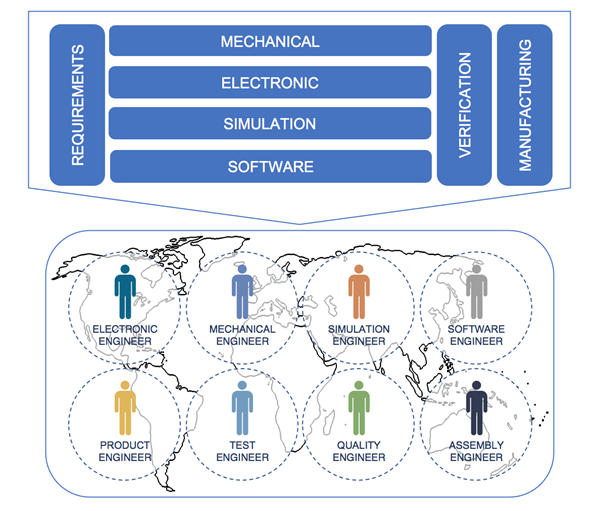
Companies need to choose a PCB design environment that not only accommodates the complexity of design but also facilitates a digital thread (Digital Thread) that allows design and manufacturing teams to stay up-to-date on project status and collaborate globally across all areas of engineering.
Digital Thread between design and production allows design and production teams to better collaborate to speed up the design process and minimize respins. Streamlining the transition to production requires sharing comprehensive product knowledge and early access to downstream data. Using a digitally integrated platform helps teams develop a comprehensive and accurate multi-domain bill of materials that companies can easily integrate with a wide variety of other business applications. Design teams can also develop templates that help enterprise-level teams reuse best practices and apply standards.
2. Model-based systems engineering (MBSE)
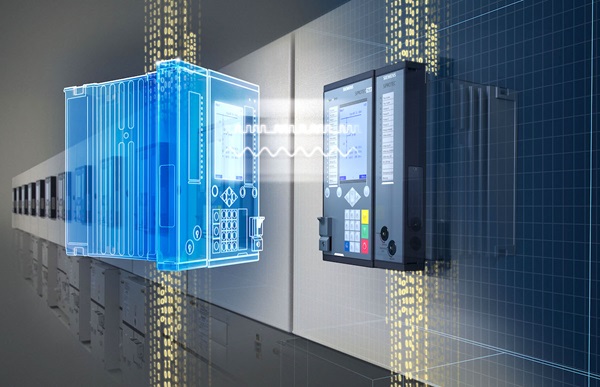
To facilitate a system-of-systems mindset, many systems companies are turning to model-based systems engineering (MBSE), where subsystems from the electrical, mechanical, and software domains-including PCB design-are functionally modeled and brought together into a complete Digital Twin at the systems architecture level before design begins.
With an MBSE methodology, architectures for electronic subsystems are extracted and communicated as "bill-of-functions", which are then used to guide the definition of the electronic system with appropriate configurations.
At the beginning of the process, system designers define all external interfaces for wiring and cable design. The electronics, defined through PCB Design, are then placed in their appropriate logical and physical implementations next.
The Digital Twin allows engineers to start working on trade-offs in different domains at a functional level early in the design cycle. Each of these trade-offs can have an impact on each of the individual domains. Therefore, the sooner you can determine which trade-offs work best for the product as a whole, the better the product will be. In addition, by looking at the whole system from a model-based systems perspective, teams can not only look at electrical and functional trade-offs early in the design cycle, but also product trade-offs that might be based on things like weight, cost, or even available components.
3. Verification guided by digital prototypes
To reduce time-to-market and maximize profitability, design teams perform analysis during the design process in short, iterative cycles.
This approach is preferred over conducting analysis only after the design has been completed or in the laboratory following the assembly of a physical prototype of the board or system.
Environments such as Xpedition enable design teams to perform analysis iteratively and create digital prototypes of their systems for much earlier validation.
Similarly, tools such as PADS Professional allow smaller PCB design teams to follow the same methodology.
Moreover, having a complete system view not only enables localized iterative cycles for correct-by-construction design but also facilitates extensive system-level analysis.
In today’s engineering environment, it is no longer possible to analyze just a few individual parts of a project outside the context of the entire system.
Performance must be analyzed and verified at the broadest system level, from 3D electromagnetic modeling of complex design structures to the creation of multi-substrate digital models that feed into power-aware, system-level signal analysis.
Heterogeneous silicon integration and advanced IC packaging now require comprehensive system-level thermal analysis along with concurrent evaluations, where the thermal effects of the IC on its package and the corresponding PCB are modeled within the context of the complete system.

4. Capacity, performance, productivity, efficiency
Companies that have been most successful in digital transformation choose PCB Design environments that fit the size of their organization, the challenges and the skills of the design team. In addition, more sophisticated environments allow companies to catalog and leverage project reuse throughout their organizations. In the IC design space, there are several advantages for reducing costs and design time, enabling the development of derivative designs throughout the organization.
.jpg?h=337&iar=0&w=600&hash=4E873397630C9BF6C37167A9AD64F398)
5. Provider strength and credibility
To undertake a digital transformation and continue to grow throughout that transformation to provide constant innovation to the market, it is necessary to partner with reliable suppliers. The latter must not only offer leading solutions for today, but also formulate new ways to make companies more successful.
Siemens and Var Industries are such suppliers. We can help companies achieve their digital transformation by offering not only a next-generation system design platform, the most comprehensive and digitally integrated in the industry. We can also offer one that works seamlessly with production, PLM, and business flows.
Request more information or your custom quote