.png?h=790&iar=0&w=1920&hash=635808DBD30E54D141D22CE5B660F00D)
To meet customer needs today, companies must be able to effectively manage product configurations.
Regardless of the product, the customer is always right. To meet these expectations, manufacturing companies must be able to effectively manage product configurations.
Configuration has traditionally been considered a “design problem,” but in reality, the range of product variants to be offered is determined long before the designer begins work, and the implications of these decisions affect everyone involved throughout the entire product lifecycle.
Configuration has traditionally been considered a “design problem,” but in reality, the range of product variants to be offered is determined long before the designer begins work, and the implications of these decisions affect everyone involved throughout the entire product lifecycle.
Take control of product configurations
The product configuration capabilities available in Teamcenter PLM allow companies to meet the demand for more advanced and differentiated products without increasing costs. You can leverage Teamcenter’s product configuration backbone to provide a common definition of variability throughout the entire product lifecycle.
Take control of product configurations, whether it involves delivering products with a predetermined set of supported variants, more complex products with an exponential number of possible variants and combinations, or custom-designed products that require new designs and part variants for each order.
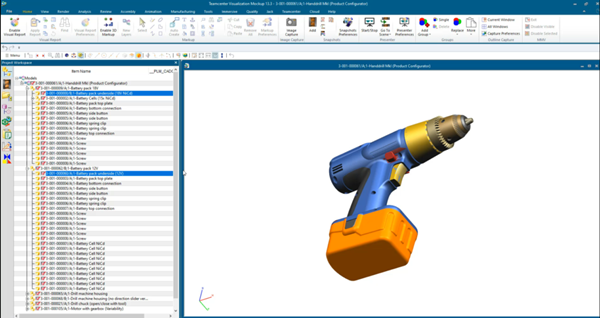
Teamcenter
Teamcenter integrates with all major CAD and ERP systems on the market, Microsoft Office, and Microsoft Visio.
What can you do with the configuration options available in Teamcenter?
Automation of rules and processes: Enables custom design capabilities to meet new customer requirements and requests quickly and easily.
Real-time 3D visualization: Allows companies to improve communication, accelerate decision-making, and enhance user satisfaction, resulting in better products and faster time-to-market.
Exceed the limits of standalone configuration systems: Teamcenter provides companies with a powerful, flexible, and scalable platform to manage complex and evolving products, ensuring greater efficiency, quality, and responsiveness to market demands.

Collaborative optimization of the product lifecycle
Utilize a single definition of variability to simplify collaboration and optimize the product lifecycle.
Teamcenter allows you to use a single definition of variability across domains and across the lifecycle. Project options are not bound to design data, but are managed independently to be utilized throughout the organization. In this way you get a configuration data source common and easy to use.
The planners can define the products, product lines, and features they wish to market so that the engineers can focus on valid configurations and the production department can generate a BOP (Bill of Process) based on the same shared definition.
Request more information or your personalized quote