.png?h=790&iar=0&w=1920&hash=0BED269844D14F2A3B09214DE1DB8841)
Introducing new products in the "High Mix Low Volume" era.
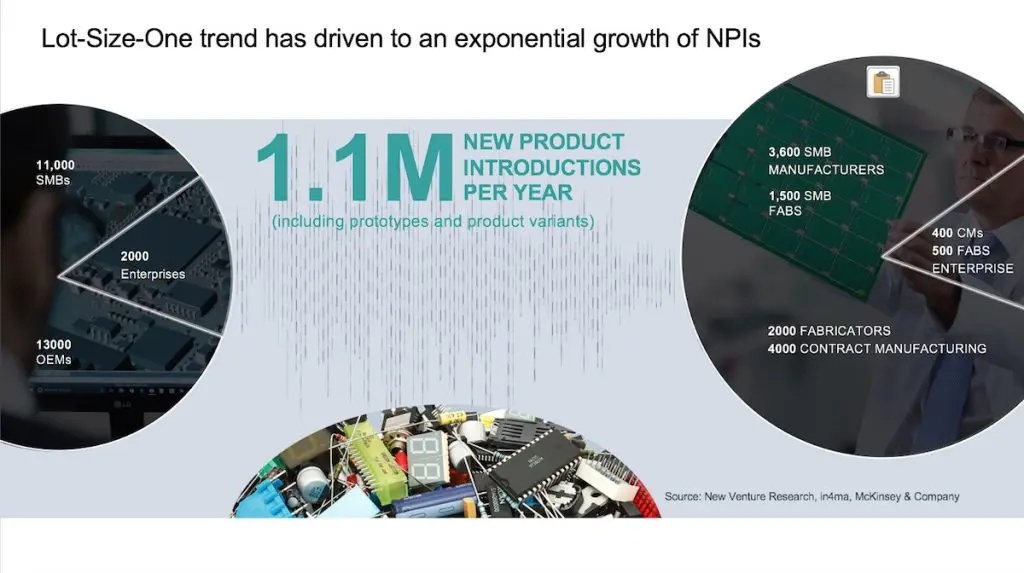
The high mix-low volume production is the main trend of our era. Many people talk about "Lot-Size-One." Ideally, it means producing a single product for a single consumer. This is the trend we are heading toward, in a rapidly changing market where the consumer demands increasingly extreme personalization.
In Industry 4.0, high mix low volume means producing a mixed set of products with a very low production volume, the opposite of mass production. From the manufacturer's point of view, the central idea of "Lot-Size-One" is to be able to make any product, in any variation, in any quantity, in any sequence, on any production line, at any time. This should be achieved without having to rewrite their business model or invest heavily in the latest technology.
How Digital Manufacturing improves the NPI process
The implementation of the high mix, low volume model is closely linked to the adoption of Digital Manufacturing on the factory floor. Digitization allows manufacturers to manage all product data in real time and at any time within the shop floor. Efficient and effective data management enables the delivery of more and more product variants in small batches and the efficient execution of necessary configuration changes.
For the New Product Introduction (NPI) of PCB assembly, in particular, the challenge is to be able to handle many new products per day, avoiding errors and revisions and ensuring quality at the highest level.
This is possible thanks to Var Industries and the Digital Manufacturing tools provided by Siemens.
For the New Product Introduction (NPI) of PCB assembly, in particular, the challenge is to be able to handle many new products per day, avoiding errors and revisions and ensuring quality at the highest level.
This is possible thanks to Var Industries and the Digital Manufacturing tools provided by Siemens.
Siemens Processing Preparation
A tool such as Siemens Process Preparation provides the technology to meet the quality improvement and time reduction goals of each NPI. In summary, the main benefits are as follows:
- reduction of errors due to inaccurate component data;
- reduction of stops due to component data loss;
- improved product quality through precise positioning of components;
- standardization of documentation;
- internal stencil design;
- normalization of NPI flow with the possibility of reuse and export to other lines or factories;
- improved product quality.
What is the process of introducing a new product
The concept of New Product Introduction (NPI), also known as New Product Development, refers to the set of activities required to bring a new industrial product to market.
Whenever a new project is created and the decision is made to move from design to production, it is referred to as a New Product Introduction.
NPI acts as the bridge between design and production, allowing the product to be evaluated from both perspectives.
The New Product Introduction process enables companies to:
- analyze the impacts of the PCB project on production
- optimize PCB design based on production volumes
- communicate complete project data to production
- generate all the documentation, programs and tools needed for production
New Product Introduction is a crucial stage in the industrial process that addresses specific challenges such as:
- excessively high waste levels during production
- poor performance in production
- difficulty meeting the delivery time
- product reliability issues
- long data preparation times for production
- excessive manpower requirements to manage process issues
- customer's request for Design for Manufacturing (DFM) services and feedback.
Siemens offers a wide range of software tools and solutions to optimize the new product introduction process in the electronics industry. Since this process begins at the design stage, Siemens provides a complete Design for Manufacturing solution with Valor NPI and Valor Parts Library (VPL). VPL is a comprehensive PCB component library containing accurate physical models for each part.
For process engineers at the start of the production phase, Siemens also provides two additional tools that support Industry 4.0 implementation and help companies digitize their manufacturing workflows: BOM Connector and Siemens Process Preparation.
How the ODB++ format improves the NPI
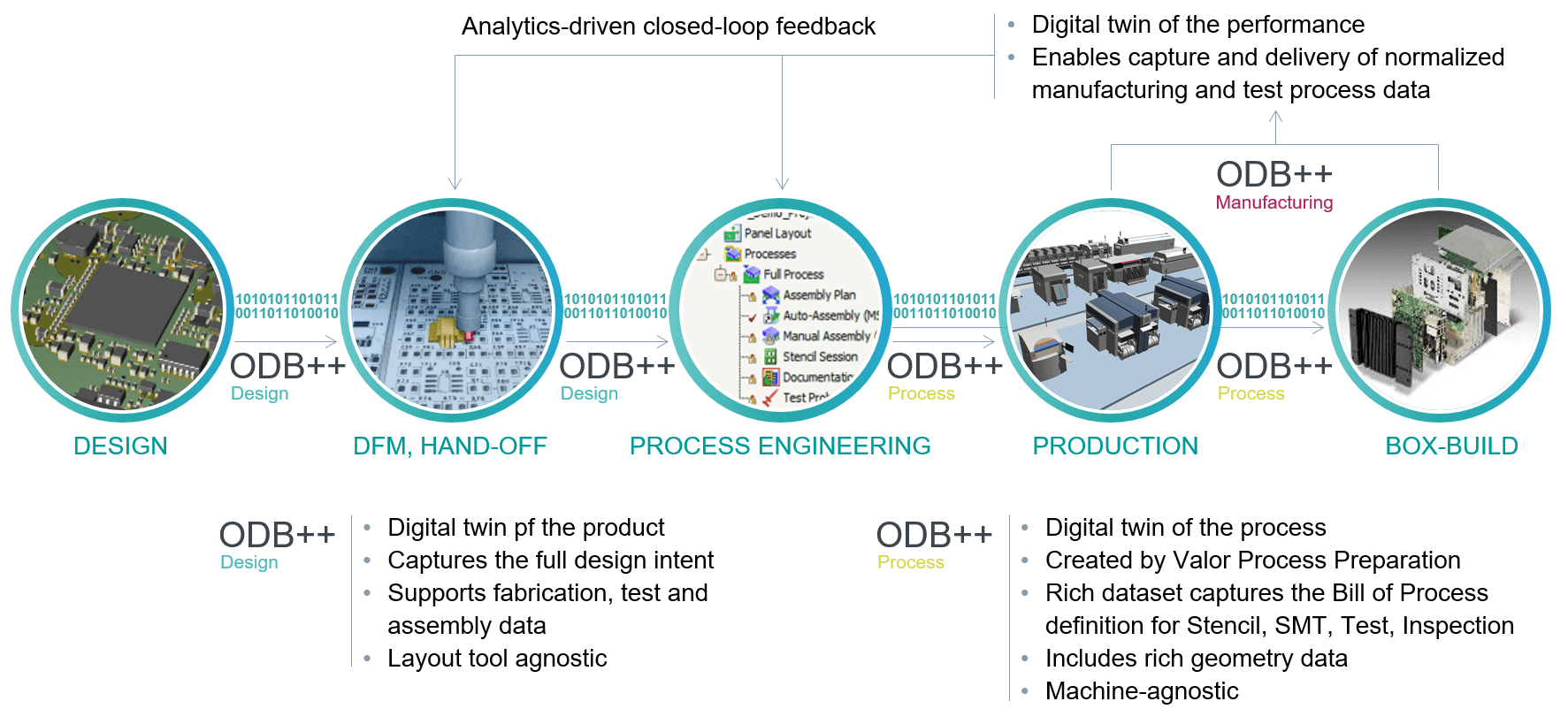
The ODB++ format, an open and intelligent data exchange format, is now a reality in the electronics industry. ODB++ Design, in particular, allows PCB designs to be transferred to production with all the information manufacturers need for a "right the first time" approach.
At the same time, ODB++ Process enables open exchange of process engineering information between production machines, software suppliers and processes, helping to accelerate new product introduction (NPI) and minimization of production issues.
Software for New Product Introduction
Request more information or your custom quote