.png?h=790&iar=0&w=1920&hash=6BD152934EBDC07ED66020A8085335B3)
Design for manufacturing: what is it?
The Design for Manufacturing (DFM) is the engineering practice of designing products in such a way that they are then easy to manufacture. The DFM facilitates the production process to reduce product manufacturing costs.
The DFM allows potential problems to be solved at the design stage, when it is less costly to deal with them, rather than later during the production process.

What are DFM and DFA?
In electronics, the term Design for Manufacturing actually refers to Design for Manufacturing and Assembly (DFMA), because the manufacturing process is divided into two completely separate activities:
- Fabrication of bare PCB (Manufacturing);
- assembly of components on the PCB (Assembly).
So, Design for Manufacturing in electronics is also known as Design for Fabrication (DFF). It is concerned with selecting cost-effective raw materials and attempting to minimize the complexity of manufacturing operations during the product design phase in order to avoid errors and re-spins, and reduce overall production time and cost for printed circuit boards.
Similarly, the Design for Assembly (DFA) is concerned with reducing assembly time, cost, and product complexity well as errors, by minimizing the number of individual parts, assembly steps, and the potential for variability in production quality.
Why is design for manufacturing important?
Design for Manufacturing (DFM) is becoming increasingly important in today’s environment, where products are growing more complex and must reach the market faster. Traditionally, prototyping and manufacturing have been used to identify DFM issues. However, this approach is inefficient, time-consuming, and costly.
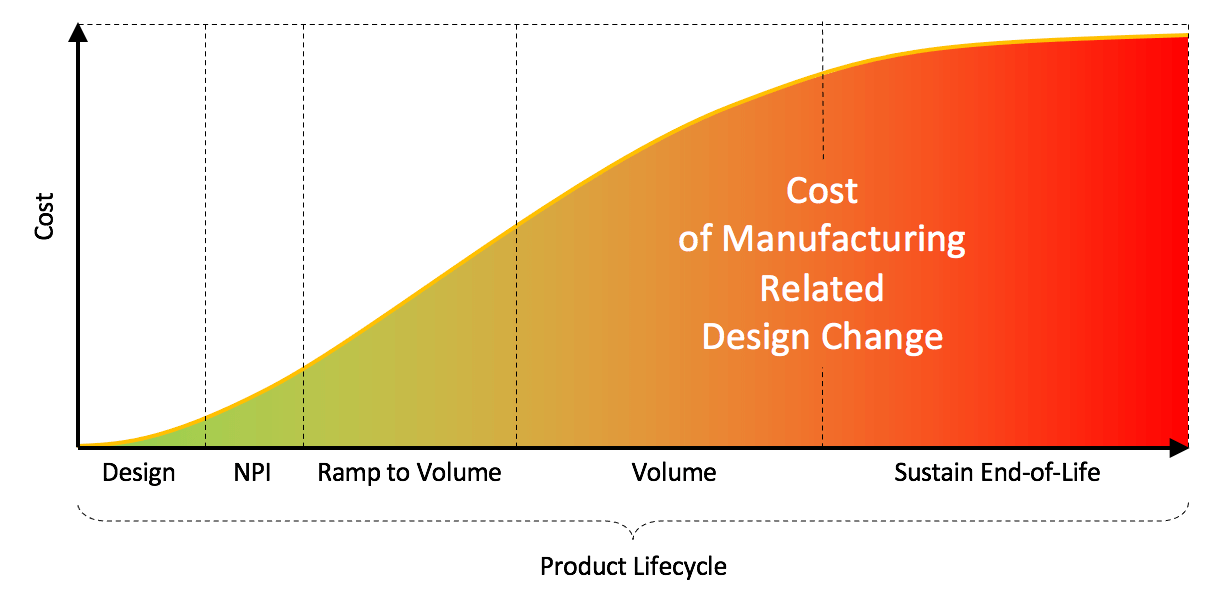
As shown in the chart below, the cost of solving a problem increases throughout the product’s life cycle. At each stage, resolving an issue costs roughly ten times more than in the previous one. The most expensive failures are those detected in the field. Therefore, the ideal scenario is one in which problems are identified as early as possible in the design process.
What are the design considerations for production?
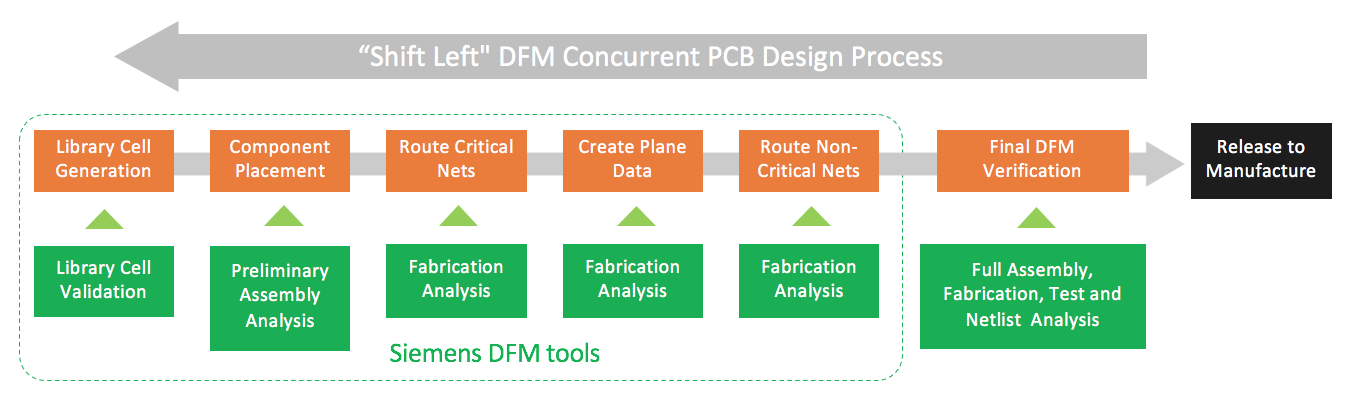
Siemens offers some important design considerations for manufacturing. It is no longer possible to consider Design and Production as two separate worlds. The whole process should be revised so that the production mentality is present at every stage of the project. This is actually quite simple.
You need to perform DFM analysis in the fundamental steps of PCB design. Detecting DFM problems early in the PB design saves time, since any corrections would be more difficult at a later stage. Siemens tools for DFM enable this "incremental DFM," which provides the responsible person with visibility into any stage of the design and release process. This approach helps PCB designers become more "production conscious."
Learn about the tools needed for design for manufacturing:
Valor NPI - Siemens' Solution for PCB DFM
Valor NPI for PCB DFM is Siemens' tool that brings real-world knowledge of PCB manufacturing, fabrication and assembly processes, directly into the PCB design flow
PCBFLOW - The Online Solution for PCB DFM
The online tool and collaboration space that accelerates the transition from design to production by connecting designers directly with manufacturers
Valor Part Library (VPL)
Valor Part Library is a PCB part library with an accurate physical model of each BOM component that accelerates the introduction of new products
CAM350
CAM350 is the de facto industry standard for DFM analysis, helping companies achieve greater efficiency, reduce the risk of design re-spins, and deliver successful products.
BluePrint-PCB
BluePrint PCB imports your PCB CAD data to help you quickly produce complete electronic drawings and reduce Time-to-Market
Get more information or request your custom quote