MES (Manufacturing Execution Systems)
Control production, improve every decision.

To meet the diverse needs of the manufacturing sector, Var Industries offers two complementary and scalable MES solutions.
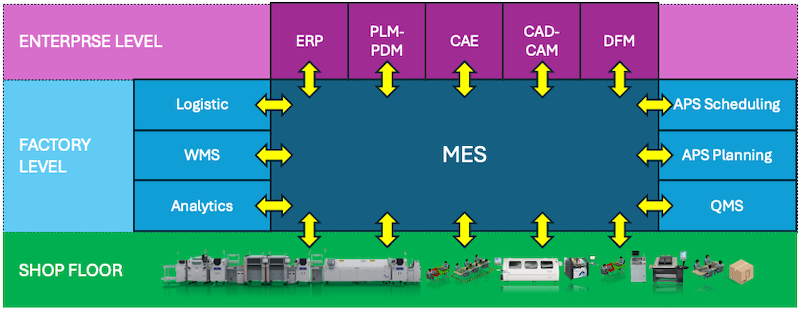
The image illustrates the central role of the MES (Manufacturing Execution System) within the corporate ecosystem.
The MES acts as an operational hub connecting the enterprise level (ERP, PLM, CAE, CAM, DFM), the factory level (logistics, warehousing, analytics, planning, and quality), and the production department (shop floor). Through bidirectional data and command flows, the MES ensures synchronization between design, planning, and production, enabling real-time process control, system integration, and the optimization of operational performance.

An MES (Manufacturing Execution System) is the system that monitors, controls and optimizes production processes in real time. It connects the shop floor to business systems such as ERP and PLM, and manages work orders, material tracking, quality and performance analysis.
Var Industries offers two complementary MES solutions: Siemens Opcenter Execution Electronics, dedicated to electronics manufacturing, and PMS, the MES developed by Var Industries for small and medium-sized businesses.
Opcenter Execution Electronics is the Siemens platform for electronics manufacturing, with traceability, process control, real-time monitoring and production constraint management. PMS is Var Industries' modular MES for high-variability environments, with modules such as PMS Manager, Traceability, Quality and Performance that allow production to be digitalized progressively.
ERP manages business processes such as orders, purchasing, inventory and accounting. MES manages the execution of production on the factory floor in real time. The two systems integrate: ERP sends the orders, MES controls their execution and reports back progress, consumption and quality data.
Yes. Var Industries' MES solutions integrate IoT and AI capabilities to collect data from machines and sensors and enable predictive management of production activities.