.png?h=790&iar=0&w=1920&hash=0832792EF12EB6AD2C6D1D94860A1D4F)
FPGA Design: simplicity and efficiency
FPGA design solutions are recognized for their ability to combine operational simplicity and computational efficiency, two crucial factors for optimizing the design process and ensuring high performance.
FPGAs are designed with an intuitive, easy-to-use interface that allows quick configuration and minimizes complexity. Furthermore, the design approach focuses on efficiency, creating architectures that maximize performance while minimizing resource usage. This makes FPGAs both easy to manage and highly efficient, ideal for advanced applications and complex engineering scenarios.
The Siemens EDA FPGA Design Flow
Is your FPGA design flow ready to meet the challenges of increasingly complex next-generation FPGAs?
Are you struggling with tools that are not fully integrated?
Can you achieve the expected quality of results within your current budget?
Are your PCB and FPGA teams able to collaborate effectively to define overall system constraints?
The Siemens EDA FPGA design flow is the answer you’ve been waiting for.
Are you struggling with tools that are not fully integrated?
Can you achieve the expected quality of results within your current budget?
Are your PCB and FPGA teams able to collaborate effectively to define overall system constraints?
The Siemens EDA FPGA design flow is the answer you’ve been waiting for.

A complete FPGA design flow
Var Industries offers integrated FPGA design solutions based on the FPGA platform provided by Siemens, which includes design entry, synthesis, verification, equivalence checking, and PCB design in order to accelerate FPGA designs from conception to finished board, meeting result quality objectives and system constraint requirements.
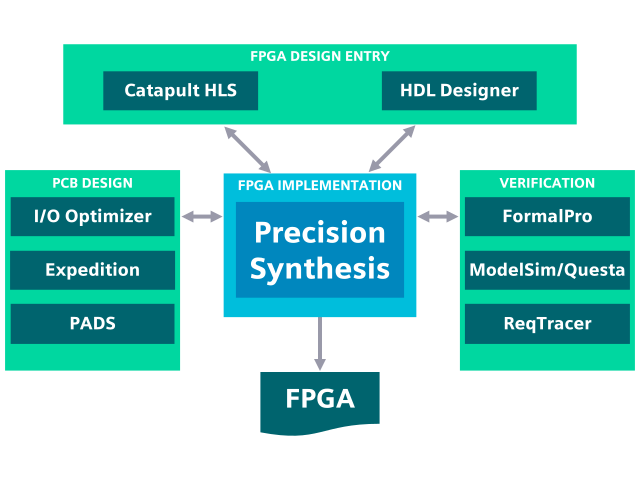
The integration of tools
To support each stage of the design flow, Siemens EDA provides a suite of highly specialized tools. Reqtracer enables complete management of requirement traceability throughout the development cycle, ensuring full consistency between specifications and implementation.
The graphical environment offered by HDL Designer streamlines the engineering of RTL architectures, while Questa Lint and Questa Base perform in-depth static analysis to detect errors, style violations, and potential bugs early in the project. Functional simulation relies on established tools such as ModelSim and Questa Prime, capable of accelerating debugging and improving coverage. For formal verification and detection of critical conditions such as asynchronous timing violations, Questa Inspect and Questa CDC. Finally, Questa Equivalence Check for FPGA enables comparison and verification of equivalence between RTL and gate-level versions, ensuring design consistency even after synthesis.
The graphical environment offered by HDL Designer streamlines the engineering of RTL architectures, while Questa Lint and Questa Base perform in-depth static analysis to detect errors, style violations, and potential bugs early in the project. Functional simulation relies on established tools such as ModelSim and Questa Prime, capable of accelerating debugging and improving coverage. For formal verification and detection of critical conditions such as asynchronous timing violations, Questa Inspect and Questa CDC. Finally, Questa Equivalence Check for FPGA enables comparison and verification of equivalence between RTL and gate-level versions, ensuring design consistency even after synthesis.
Software for FPGA design and verification
Show more